How the Funza Lushaka Bursary Is Helping Thousands of South African Students Become Teachers
For many young South Africans, becoming a teacher is more than just a career choice. It represents an opportunity to shape communities, inspire future generations, and build long-term stability through meaningful employment. However, the rising cost of higher education continues to prevent many qualified students from pursuing teaching degrees. Funza Lushaka Bursary Application South Africa
Thank you for reading this post, don't forget to subscribe!This is where the Department of Basic Education-backed Funza Lushaka Bursary Programme has become one of the country’s most important education funding initiatives.
Every year, thousands of students apply for the bursary in hopes of securing financial support for university tuition, accommodation, textbooks, meals, and related study expenses. The programme is specifically designed to address South Africa’s ongoing shortage of qualified teachers in critical subjects and underserved areas.
For students considering a future in education, understanding how the bursary works is essential. From eligibility requirements and application steps to service obligations after graduation, applicants must fully understand the process before applying.
This guide explains everything prospective applicants need to know about the Funza Lushaka Bursary Programme for 2026.
What Is the Funza Lushaka Bursary Programme?
The Funza Lushaka Bursary Programme is a government-funded teaching bursary aimed at supporting students who want to pursue teaching qualifications at approved public universities in South Africa.
The programme is managed by the Department of Basic Education in partnership with provincial education departments and participating universities.
Unlike ordinary student loans, the bursary functions as a funding-for-service programme. This means students who receive funding are expected to teach at public schools after completing their qualifications.
The initiative was introduced to help address teacher shortages in priority subject areas where South African schools urgently require skilled educators.
Why the Funza Lushaka Bursary Matters in South Africa
South Africa continues to face major challenges within the education sector, particularly in rural and underserved communities where qualified teachers remain in short supply.
The Funza Lushaka programme plays a critical role in:
- Encouraging talented students to enter the teaching profession
- Increasing the number of teachers in scarce subject areas
- Supporting students from financially disadvantaged backgrounds
- Improving long-term education outcomes in public schools
The bursary has become especially valuable as university costs continue to rise across the country.
For many students, the programme offers an opportunity to study without accumulating large amounts of debt.
What the Funza Lushaka Bursary Covers
One of the main reasons the bursary attracts high demand is the broad range of expenses it can help cover.
Approved students may receive funding for:
- University tuition fees
- Registration costs
- Accommodation
- Meals
- Prescribed textbooks
- Learning materials
- Limited living allowances where applicable
Funding amounts vary depending on:
- The university attended
- The approved study budget
- Available government funding
- Individual student needs
In most cases, payments are made directly to the university.
Priority Teaching Subjects Supported by the Programme
The bursary focuses heavily on subjects where South Africa faces teacher shortages.
Priority areas commonly include:
Mathematics
Mathematics teachers remain in high demand across South African public schools.
Physical Sciences
Science education is considered a national priority for economic and technological development.
African Languages
Teachers qualified to teach African languages are increasingly needed in schools nationwide.
Technology and Technical Subjects
Technical education has become essential for skills development and employment readiness.
Foundation Phase Teaching
Early childhood and foundation phase educators remain critical to improving literacy and numeracy rates.
Special Needs Education
Teachers trained in inclusive and special needs education are also in demand.
Students studying these subjects may improve their chances of securing funding.
Who Can Apply for the Funza Lushaka Bursary?
The programme is open to several categories of South African students.
Applicants generally qualify if they are:
- South African citizens
- Interested in becoming teachers
- Accepted into an approved teaching qualification
- Studying at a recognised public university
- Academically capable of completing their studies successfully
Students Who Usually Qualify
The bursary is commonly open to:
Grade 12 Learners
Matric students planning to study teaching at university may apply.
Current University Students
Students already enrolled in teaching qualifications can also apply.
Graduates Pursuing a PGCE
Graduates who want to complete a Postgraduate Certificate in Education may qualify.
Career-Changing Students
Some students changing from another qualification into education may also be eligible.
Approved Teaching Qualifications
The bursary mainly supports students enrolled in accredited teaching programmes.
Commonly funded qualifications include:
Bachelor of Education (BEd)
This is the primary undergraduate teaching qualification.
Postgraduate Certificate in Education (PGCE)
The PGCE is designed for graduates who already hold a bachelor’s degree in another field.
Only approved public universities typically participate in the programme.
Academic Requirements for Applicants
Meeting the minimum requirements does not automatically guarantee funding.
Competition for bursary placements remains extremely high each year.
Requirements for Grade 12 Learners
Applicants usually need strong academic performance in subjects linked to their teaching specialisation.
Good marks in the following subjects are often important:
- Mathematics
- Languages
- Physical Sciences
- Relevant school subjects connected to intended teaching areas
Requirements for University Students
Current university students are typically expected to:
- Pass most or all modules
- Maintain satisfactory academic progress
- Demonstrate strong overall performance
Students with weak academic records may struggle to secure approval.
Documents Needed for the Funza Lushaka Application
Preparing documents early can help applicants avoid delays and rejection.
Applicants are usually required to upload certified copies of:
- South African ID document
- Latest academic results
- Grade 12 results or matric certificate
- University transcripts
- Proof of university admission or application
- Graduation certificate if applicable
- Proof of residence if requested
Documents must be clear, readable, and correctly certified.
Incomplete applications are frequently rejected.
Step-by-Step Guide to Applying for the Funza Lushaka Bursary
Applying online is the official method used for the programme.
Here is a breakdown of the application process.
Step 1: Visit the Official Funza Lushaka Portal
Applicants must use the official government bursary portal to begin the process.
Students should avoid unofficial websites or social media pages claiming to process applications for payment.
Step 2: Create an Online Account
Applicants will need to register using:
- South African ID number
- Email address
- Mobile number
- Password
Using active contact details is essential because updates are usually sent electronically.
Step 3: Verify Your Account
Applicants may receive:
- An email verification link
- A One-Time Pin (OTP)
- SMS verification instructions
Verification must be completed before continuing.
Step 4: Log In and Access the Application Form
Once verified, applicants can sign in and begin the bursary application.
Step 5: Complete the Application Form
Students will need to provide:
- Personal details
- Contact information
- Academic history
- University information
- Intended teaching specialisation
All information should be accurate and truthful.
Step 6: Upload Supporting Documents
Accepted document formats often include:
- JPEG
- PNG
Blurry or unreadable files may lead to rejection.
Step 7: Review the Application Carefully
Before submitting, applicants should:
- Double-check personal information
- Confirm uploaded documents
- Verify email and cellphone details
Mistakes can delay processing.
Step 8: Submit the Application
After submission, applicants should:
- Save the reference number
- Take screenshots if possible
- Keep backups of all uploaded documents
These records may be useful later.

How Applications Are Selected
The selection process considers several factors.
These may include:
- Academic performance
- Priority teaching subjects
- Provincial education needs
- Available bursary funding
- Demand for teachers in specific areas
Because applications often exceed available funding, approval is highly competitive.
What Happens After Approval?
Successful applicants are usually required to:
- Accept the bursary agreement
- Register at their university
- Comply with programme conditions
Students should carefully read all contractual obligations before accepting funding.
Understanding the Service Obligation Requirement
One of the most important aspects of the bursary is the work-back obligation.
Graduates funded through the programme are generally required to teach at public schools after completing their qualifications.
The service period usually matches the number of years funded.
For example:
- A student funded for four years may be expected to teach for approximately four years.
Placement decisions are often made based on where teachers are most urgently needed.
What Happens if Students Break the Agreement?
Failure to meet bursary conditions may result in repayment obligations.
This could happen if a student:
- Drops out of university
- Repeatedly fails modules
- Refuses a placement offer
- Does not complete the required teaching service
Applicants should fully understand the terms before accepting funding.
Tips to Improve Your Chances of Approval
With high competition every year, applicants should approach the process carefully.
Apply Early
Late applications are often not considered.
Choose Priority Subjects
Students studying scarce subjects may have stronger chances.
Maintain Strong Academic Results
Academic performance remains one of the most important selection factors.
Upload Correct Documents
Missing or invalid documents commonly lead to rejection.
Use Official Information Sources
Applicants should avoid scams and unofficial “agents.”
Common Reasons Applications Are Rejected
Applications may be declined due to:
- Poor academic results
- Incorrect personal information
- Missing documents
- Invalid ID numbers
- Ineligible qualifications
- Late submissions
Attention to detail is essential throughout the application process.
Universities Commonly Linked to the Programme
Students funded through Funza Lushaka often study at institutions such as:
- University of Pretoria
- University of Johannesburg
- University of South Africa
- University of KwaZulu-Natal
- North-West University
Funding availability may differ depending on the institution and programme.
Can Students Receive NSFAS and Funza Lushaka Funding Together?
In many cases, students are not funded simultaneously by both Funza Lushaka and the National Student Financial Aid Scheme for the same study costs.
However, funding policies can change.
Students are encouraged to confirm details directly with their university financial aid office.
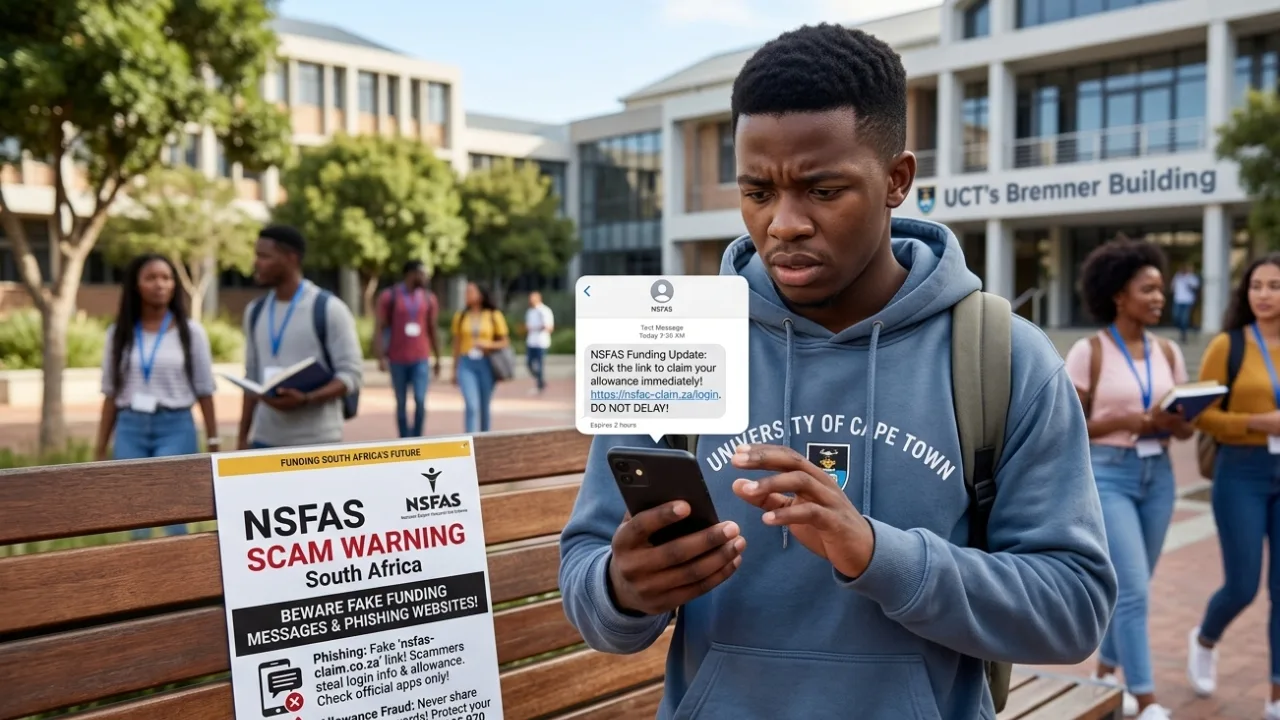
Warning About Funza Lushaka Scams
Scammers frequently target students searching for bursaries online.
Applicants should remember:
- Official applications are completed online through government systems
- Nobody can guarantee approval
- Students should never pay anyone to apply on their behalf
- Government departments do not sell application forms
Using only official government platforms is critical.
Why Teaching Should Be More Than Just a Funded Opportunity
Education experts continue to stress that students should not apply solely because funding is available.
Teaching requires:
- Patience
- Leadership
- Communication skills
- Commitment to communities
- Long-term dedication
Students who genuinely want to build careers in education are more likely to succeed both academically and professionally.
For many young South Africans, the bursary has become a life-changing opportunity that removes major financial barriers while creating a pathway into a respected profession.
Frequently Asked Questions (FAQs)
Is Funza Lushaka a bursary or a loan?
It is a bursary linked to a service obligation. Graduates are expected to teach in public schools after completing their studies.
Can Grade 12 learners apply?
Yes. Current matric learners planning to study teaching may apply.
Does the bursary cover accommodation?
Yes. Approved accommodation costs are generally included as part of the funding package.
Can students at private universities apply?
The programme mainly supports approved public universities.
What qualifications are funded?
The bursary commonly funds Bachelor of Education (BEd) and PGCE qualifications.
Is funding guaranteed if I meet the requirements?
No. Funding remains competitive and depends on available bursary allocations.
What subjects have the best chances of approval?
Priority subjects such as Mathematics, Science, Technology, African Languages, and Special Needs Education may improve approval chances.
Can students lose the bursary?
Yes. Students who fail academically or violate programme conditions may lose funding and may have to repay the bursary.
Final Thoughts
The Funza Lushaka Bursary Programme continues to serve as one of South Africa’s most important teacher development initiatives.
At a time when the country urgently needs skilled educators, the programme gives financially disadvantaged students a realistic opportunity to pursue teaching qualifications without carrying overwhelming financial pressure.
For students passionate about education, community development, and long-term career stability, the bursary can provide a direct pathway into the public education system.
However, applicants should approach the programme with a full understanding of its responsibilities, especially the teaching service commitment after graduation.
Students who prepare early, maintain strong academic results, and carefully follow the application process may significantly improve their chances of success.
Disclaimer
This article is intended for informational and educational purposes only. Bursary requirements, funding allocations, application dates, and eligibility criteria may change at any time. Applicants should always verify the latest information through official government and university channels before applying.
Related posts:

Amina Sechaba is a passionate career writer and employment researcher dedicated to helping South Africans find better job opportunities and prepare for successful careers. With years of experience in content writing and career development, Amina creates informative articles, application guides, and interview tips that empower job seekers to reach their full potential. Through her work with Submit Your CV, she aims to simplify the job application process and provide reliable information on learnerships, internships, and career advice for both students and professionals.