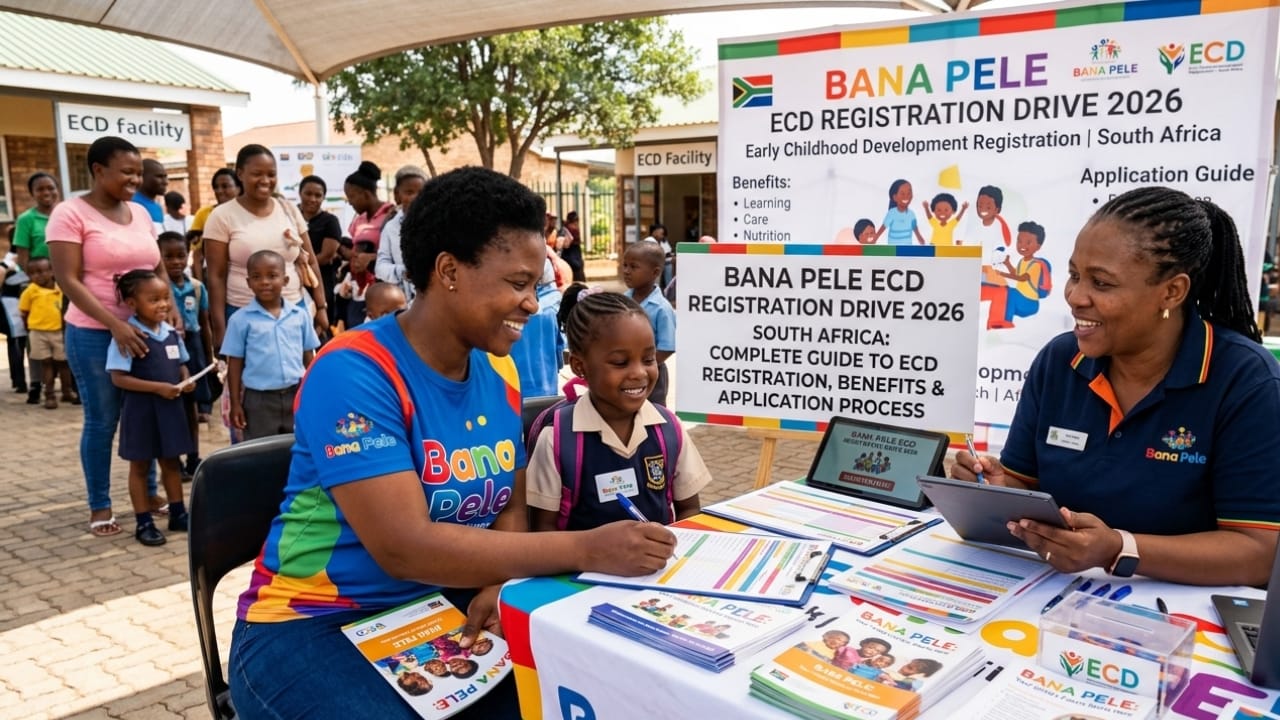
Introduction: A National Shift Toward Stronger Early Childhood Development
Early Childhood Development (ECD) is widely recognised as one of the most important foundations for lifelong learning, cognitive development, and social wellbeing. In South Africa, the government has intensified efforts to strengthen this foundation through a major reform initiative known as the Bana Pele ECD Registration Drive 2026. Bana Pele ECD Registration Drive 2026 South Africa
Led by the Department of Basic Education (DBE), this national programme is designed to ensure that every child—regardless of geography or socio-economic background—has access to safe, structured, and high-quality early learning environments.
The initiative represents more than administrative reform. It is part of a broader national vision to improve school readiness, standardise early education quality, and ensure accountability across all ECD centres including crèches, preschools, day-care facilities, and community-based programmes.
At its core, the Bana Pele Registration Drive aims to simplify the registration process, improve compliance systems, and build a unified national database of registered ECD providers.
What Is the Bana Pele ECD Registration Drive 2026?
The Bana Pele ECD Registration Drive is a government-led digital transformation programme that allows Early Childhood Development centres to register more easily through an online system and supported mobile channels.
This initiative is part of South Africa’s shift in ECD oversight from the Department of Social Development (DSD) to the Department of Basic Education (DBE). The transition reflects a stronger focus on learning outcomes, school readiness, and structured early childhood education.
Key Purpose of the Programme
The main objectives include:
- Simplifying ECD registration processes
- Improving transparency and accountability
- Ensuring all children access safe and quality learning environments
- Supporting ECD practitioners with compliance tools and training
- Building a national ECD data system for better planning and funding allocation
This transformation ensures that early learning is treated as a formal part of the education system rather than an informal service.
Why the Bana Pele Registration Drive Matters in 2026
South Africa continues to face challenges such as inequality in education access, under-resourced rural centres, and inconsistent quality standards in early learning institutions.
The Bana Pele initiative directly responds to these issues by:
- Standardising quality requirements across all provinces
- Providing equal access to registration tools through digital platforms
- Strengthening government oversight and support mechanisms
- Ensuring children receive early stimulation and foundational learning before Grade R
By prioritising ECD, the government aims to improve long-term educational outcomes and reduce dropout rates in later schooling stages.
Core Objectives of the Bana Pele ECD Registration Drive
The registration drive is built around three strategic pillars:
1. Universal Access to ECD Services
Every child in South Africa should have access to a registered, safe, and structured early learning environment regardless of location.
2. Quality Assurance and Compliance
All centres must meet minimum safety, nutrition, and educational standards to ensure consistency in care and learning outcomes.
3. Practitioner Support and System Inclusion
The programme recognises that many ECD centres operate in diverse conditions. Therefore, it provides step-by-step assistance to help centres comply without being excluded due to limited resources.
Step-by-Step Guide to ECD Registration Process
The Bana Pele system introduces a structured three-stage process designed to simplify registration and compliance.
Step 1: Apply (Bronze Certificate Stage)
ECD centres begin by submitting an online application through the official DBE registration platform.
Once the application is successfully submitted, the centre receives a Bronze Certificate, which confirms entry into the national ECD system.
What happens during this stage:
- Online or mobile-based application submission
- Basic organisational details are captured
- Initial verification of centre existence
- Immediate recognition as a registered applicant
This stage ensures that even informal or rural centres can begin the process without complex paperwork.
Step 2: Comply (Verification and Assessment Stage)
Once registered, centres must upload supporting documents and undergo compliance checks.
Required documentation may include:
- Health and safety compliance certificates
- Staff qualifications and training records
- Facility layout and infrastructure details
- Nutrition and meal planning programmes
- Child protection policies
Officials may also conduct site visits to verify compliance with national standards.
This step ensures that centres meet minimum requirements for child safety, education quality, and operational integrity.
Step 3: Complete (Silver or Gold Certification)
After successful verification and compliance, centres are awarded either:
- Silver Certificate – Partial compliance with ongoing improvement requirements
- Gold Certificate – Full compliance with all DBE standards
These certifications serve as official recognition of quality and trustworthiness, helping parents make informed decisions.
✅ Useful Links:
- Register here: https://user-registration.dbecares.gov.za/
- Email for enquiries: banapele@dbe.gov.za
- Report fraud: banapele@dbe.gov.za
Phased Rollout of the Bana Pele ECD System
The DBE has implemented a phased rollout strategy beginning with pilot projects in Gauteng Province.
Why a phased approach is important:
- Identifies and fixes technical system issues early
- Allows training materials to be refined based on real feedback
- Ensures smooth scaling to other provinces
- Reduces disruption for ECD centres
After successful pilot testing, the programme will be expanded nationally across all provinces in South Africa, ensuring consistent access for all ECD providers.
Role of NGOs in the Bana Pele Registration Drive
Non-governmental organisations (NGOs) play a critical role in supporting the success of this initiative.
Many ECD centres, especially in rural and underserved communities, rely heavily on NGO support.
NGO responsibilities include:
- Assisting with online application submissions
- Training ECD staff on compliance requirements
- Supporting infrastructure improvements
- Guiding centres through site inspections
- Providing capacity-building workshops
This collaboration ensures that no ECD centre is left behind due to technological or resource limitations.
Key Benefits of Registering an ECD Centre
Registration under the Bana Pele system is not only mandatory but also highly beneficial.
1. Increased Credibility and Trust
Registered centres are recognised by government authorities, increasing trust among parents and communities.
2. Access to Funding Opportunities
Only registered centres are eligible for government subsidies and donor funding support.
3. Professional Development Opportunities
Centres gain access to training programmes and educational resources provided by DBE partners.
4. Improved Safety and Learning Standards
Compliance ensures children are cared for in safe, structured, and developmentally appropriate environments.
5. Integration into National Education System
Registered centres become part of a national database that supports long-term planning and improvement.
How to Apply for Bana Pele ECD Registration
Applying for registration is simple, free, and accessible online.
Steps to apply:
- Visit the official registration portal
- Complete the application form
- Upload required documents
- Track application progress online
Official registration portal:
Bana Pele ECD Registration Portal
Important contact:
For enquiries: banapele@dbe.gov.za
Fraud warning:
Registration is completely free. Applicants should not pay any individual or organisation claiming to speed up the process. Fraud cases should be reported directly to the DBE.
Why This Initiative Matters for Parents and Communities
The Bana Pele ECD Registration Drive is not only beneficial for centres but also for families and communities.
For parents:
- Assurance that children are in safe environments
- Ability to verify registration status of ECD centres
- Improved confidence in early learning quality
For communities:
- Stronger educational foundations for children
- Improved child health and nutrition outcomes
- Long-term economic and social development benefits
Quality early childhood education is strongly linked to improved academic performance in later schooling years.
Future Outlook: The Vision for ECD in South Africa
By 2030, the government aims to achieve near-universal registration and compliance of ECD centres across South Africa.
Long-term goals include:
- 100% registration of operational ECD centres
- Standardised national quality benchmarks
- Improved school readiness for Grade R learners
- Reduced inequality in early education access
This initiative represents a long-term investment in South Africa’s human capital development.
Frequently Asked Questions (FAQs)
1. Who needs to register under Bana Pele?
All ECD programmes including crèches, preschools, daycare centres, playgroups, and community-based learning facilities.
2. Is registration mandatory?
Yes. All ECD centres are expected to register to operate within the national system.
3. How much does registration cost?
Registration is completely free of charge.
4. How long does the process take?
The Bronze stage is issued immediately after application. Full certification depends on compliance readiness.
5. Can informal or rural centres apply?
Yes. The system is designed to support all types of centres, including informal and rural facilities.
6. What happens if a centre does not comply?
Centres receive guidance and support to meet standards before final certification.
7. Where can I apply?
Applications are submitted online through the official DBE portal.
Conclusion: A Transformative Step for Early Learning in South Africa
The Bana Pele ECD Registration Drive 2026 South Africa represents a major transformation in how early childhood education is managed, supported, and regulated.
By introducing a simplified digital registration system, strengthening compliance standards, and supporting practitioners through NGOs and government structures, the initiative ensures that every child has access to quality early learning opportunities.
This is more than a policy change—it is a long-term investment in South Africa’s future workforce, education system, and social development.
Professional Disclaimer
This article is for informational purposes only and is based on publicly available programme details. While every effort has been made to ensure accuracy, applicants should always refer to official Department of Basic Education communication channels for the most up-to-date and verified information regarding the Bana Pele ECD Registration Drive.

Amina Sechaba is a passionate career writer and employment researcher dedicated to helping South Africans find better job opportunities and prepare for successful careers. With years of experience in content writing and career development, Amina creates informative articles, application guides, and interview tips that empower job seekers to reach their full potential. Through her work with Submit Your CV, she aims to simplify the job application process and provide reliable information on learnerships, internships, and career advice for both students and professionals.