Introduction
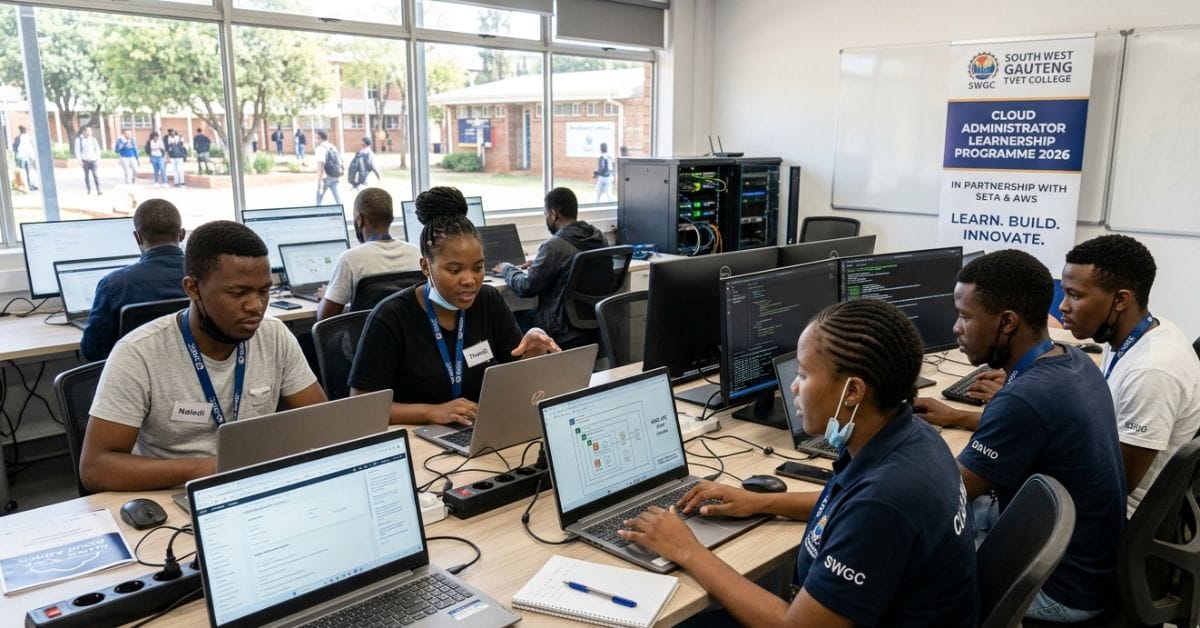
South Africa’s digital economy continues to expand, creating demand for entry-level IT professionals with practical, job-ready skills. For young people who want to enter the tech industry without a university degree, the Cloud Administrator Learnership Programme 2026 South West Gauteng TVET College presents a valuable opportunity.
Thank you for reading this post, don't forget to subscribe!This 12-month occupational certificate programme is designed to equip learners with foundational and intermediate knowledge in cloud computing, cybersecurity, databases, and modern digital workplace skills. With a monthly stipend of R3 850 and structured classroom-based learning, the programme offers both financial support and career-focused training.
Applications are currently open, with a strict closing date of 17 April 2026.
Programme Overview
The Cloud Administrator Learnership Programme is a nationally recognised qualification aligned with industry needs. It focuses on preparing learners for real-world IT environments where cloud technologies are central to operations.
Key Details:
- Programme: Cloud Administrator Learnership (Occupational Certificate)
- Institution: South West Gauteng TVET College
- SAQA ID: 111699
- NQF Level: Level 4
- Credits: 149
- Duration: 12 months
- Start Date: 4 May 2026
- Study Mode: Classroom-based
- Monthly Stipend: R3 850
- Application Deadline: 17 April 2026
This structured programme combines theoretical learning with practical exposure, ensuring that learners develop both technical and workplace readiness skills.
Why This Learnership Matters in 2026
Cloud computing is no longer a niche skill. Businesses across banking, retail, healthcare, and government sectors rely on cloud infrastructure to operate efficiently. This shift has created a growing need for cloud administrators who can manage systems, secure data, and support digital transformation.
For South African youth, especially those without access to university education, this learnership provides:
- A direct pathway into the IT industry
- Industry-relevant skills aligned with global standards
- A recognised qualification at NQF Level 4
- Financial support during training
It is particularly relevant in the context of the Fourth Industrial Revolution, where digital skills are becoming essential for employability.
What You Will Learn
The programme offers a comprehensive curriculum that blends technical knowledge with practical application. Below is a breakdown of the key modules.
1. Introduction to Cloud Computing
Learners begin with foundational concepts, including:
- What cloud computing is and how it works
- Different cloud service models
- Deployment models such as public, private, and hybrid clouds
This module builds the base for understanding enterprise-level IT systems.
2. Core Elements of Cloud Infrastructure
This section focuses on the building blocks of cloud environments:
- Storage systems
- Compute services
- Networking fundamentals
- Virtualisation technologies
Understanding these components enables learners to support real IT operations effectively.
3. Containers, Cloud Native Technologies and Kubernetes
One of the most advanced and valuable modules, this section introduces:
- Docker fundamentals
- Kubernetes basics
- Scalable application deployment
- Cloud automation workflows
These are in-demand skills used by major global organisations and are rarely offered at entry-level programmes.
4. Cloud Security and Risk Management
Security is a critical aspect of cloud computing. Learners will explore:
- Common cloud security threats
- Identity and access management
- Authentication principles
- Data protection responsibilities
- Vulnerability awareness
This module also opens pathways into entry-level cybersecurity roles.
5. Cloud Databases and Data Management
Learners are introduced to data handling in cloud environments:
- Database hosting
- Structured vs unstructured data
- Backup and recovery strategies
- Storage optimisation
These skills are applicable across multiple industries.
6. Cloud Platform Fundamentals
This module explains how major cloud platforms are structured:
- Infrastructure as a Service (IaaS)
- Platform as a Service (PaaS)
- Software as a Service (SaaS)
Understanding these layers helps learners navigate modern IT ecosystems.
7. Governance, Legislation and Ethics
Learners gain insight into legal and ethical responsibilities in IT:
- Data privacy laws
- Digital governance frameworks
- Ethical technology use
- Compliance requirements
These skills are essential in regulated sectors like finance and healthcare.
8. Future Skills and the Fourth Industrial Revolution (4IR)
This forward-looking module covers:
- Automation and AI trends
- Digital transformation
- Career adaptability in tech
It helps learners understand how the job market is evolving.
9. Innovative Thinking and Problem Solving
Beyond technical skills, the programme also develops:
- Critical thinking
- Creative problem-solving
- Collaboration techniques
- Innovation strategies
These soft skills are increasingly valued by employers.
Who Should Apply Cloud Administrator Learnership Programme 2026 South West Gauteng TVET College?
The Cloud Administrator Learnership Programme is designed for individuals who want to enter the tech field quickly and practically.
Ideal candidates include:
- Unemployed youth under the age of 35
- Grade 11 or Grade 12 graduates
- Aspiring IT professionals without university access
- TVET graduates seeking specialisation
- Beginners interested in cloud computing careers
This programme is especially suitable for those looking to build a career in the digital economy.
Entry Requirements
To qualify for the programme, applicants must meet the following criteria:
- Must be under 35 years old
- Must have completed at least Grade 11
- Must have basic computer literacy
- Must be able to attend classroom-based training
- Must submit certified copies of required documents
Preference may be given to former students of South West Gauteng TVET College.
Required Documents
Applicants must prepare and hand-deliver a complete application package, including:
- Application letter
- Updated CV
- Certified copy of ID
- Certified copies of qualifications
- Proof of residence
- Banking details
Incomplete applications may reduce your chances of selection.
Monthly Stipend and Financial Support
Successful applicants will receive a monthly stipend of R3 850 for the duration of the programme.
This stipend is intended to assist with:
- Transport costs
- Meals
- Learning materials
- Basic living expenses
While it is not a full salary, it significantly reduces financial barriers to learning.
How to Apply Cloud Administrator Learnership Programme 2026 South West Gauteng TVET College
Applications must be submitted in person. No online applications are accepted.
Submission Address:
South West Gauteng TVET College
New Division for Business Development Office Park
383 Ontdekker Road
Florida, Gauteng
Important Application Tips:
- Ensure all documents are certified
- Include a professional CV
- Write a short motivation letter explaining your interest in IT
- Submit your application before the deadline
Closing Date: 17 April 2026
Late applications are unlikely to be considered.
Expert Tips to Improve Your Application (E-E-A-T Focus)
With increasing competition for technology learnerships, applicants should take extra steps to stand out.
1. Build a Strong CV
Highlight any computer-related skills, even basic ones such as Microsoft Office or internet usage.
2. Write a Clear Motivation Letter
Explain why you are interested in cloud computing and how the programme fits your career goals.
3. Complete Free Online Courses
Short courses can strengthen your application. Consider:
- Microsoft Learn fundamentals
- Google Digital Skills courses
- Basic cybersecurity awareness training
4. Apply Early
Submitting your application early shows seriousness and avoids last-minute errors.
Career Opportunities After Completion
Completing this learnership opens doors to several entry-level roles, including:
- Junior Cloud Administrator
- IT Support Technician
- Help Desk Analyst
- Cloud Support Associate
- Junior Systems Administrator
It also provides a foundation for further studies in IT and cloud computing.
Frequently Asked Questions (FAQs)
Is the application free?
Yes. The programme is fully funded, and selected learners receive a monthly stipend.
Do I need matric to apply?
No. A minimum of Grade 11 and basic computer literacy is required.
Is accommodation provided?
No accommodation support is mentioned. Applicants should arrange their own transport and housing.
Will I receive a qualification?
Yes. Learners receive an Occupational Certificate at NQF Level 4 (SAQA ID 111699).
Can I apply if I studied something else before?
Yes. Previous qualifications do not prevent you from applying.
Is the stipend guaranteed?
Only applicants who are successfully accepted into the programme will receive the stipend.
Final Thoughts: Cloud Administrator Learnership Programme 2026 South West Gauteng TVET College
The Cloud Administrator Learnership Programme 2026 at South West Gauteng TVET College is one of the most accessible and practical entry points into the IT industry in South Africa today. With no university degree required, a structured curriculum, and financial support, it provides a realistic pathway into the digital workforce.
As cloud computing continues to shape the future of work, programmes like this are essential for empowering young South Africans with relevant, in-demand skills. If you meet the requirements and are serious about building a career in technology, this opportunity is worth pursuing.
Submit your application before 17 April 2026 and take the first step toward a future in cloud computing.

Amina Sechaba is a passionate career writer and employment researcher dedicated to helping South Africans find better job opportunities and prepare for successful careers. With years of experience in content writing and career development, Amina creates informative articles, application guides, and interview tips that empower job seekers to reach their full potential. Through her work with Submit Your CV, she aims to simplify the job application process and provide reliable information on learnerships, internships, and career advice for both students and professionals.